Showing posts with label * UNESCO. Show all posts

Wednesday, December 25, 2024

Halebeedu: Natya Saraswathi

Hoysaleshwara temple, also referred simply as the Halebidu temple, is a 12th-century Hindu temple dedicated to the god Shiva. The temple was built on the banks of a large man-made lake, and sponsored by King Vishnuvardhana of the Hoysala Empire. Its construction started around 1121 CE and was complete in 1160 CE. Natya Saraswathi is found on the outer wall of the temple.


Type I

Type II

Type III
Cancellation was introduced on .02.01.1978
Halebidu Sub Post Office
Halebidu-573121
Hassan District

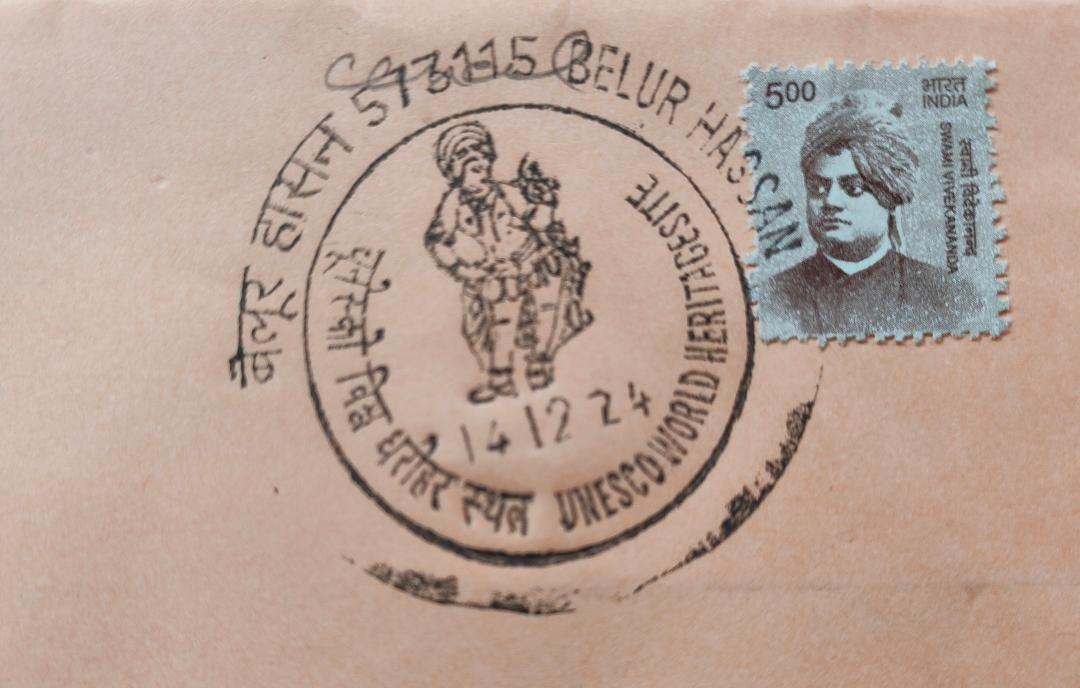
Belur: Darpana Sundari


Chennakeshava Temple of Belur, is a 12th-century temple in Hassan district. It was commissioned by King Vishnuvardhana in 1117 CE, on the banks of the Yagachi River in Belur, an early Hoysala Empire capital. Darpana Sundari (Celestial Maiden with mirror) is mounted on a pillar on the left side of main entrance. She is holding a mirror and looking at herself. She is wearing fine jewellery and beautiful dress. Her elegant stance suggests she is a dancer, and it appears as though she is looking into the mirror just before the start of a dance performance.


Type 1

Type II

Cancellation was introduced on 02.01.1978
Belur Sub Post Office
Belur- 573115
Hassan District 

Somanathapura: Sri Chennakeshava Temple

Somanathapura is a town located 35 km from the historic Mysore city in Mysore district, Karnataka state, India. Somanathapura is famous for the Chennakesava Temple (also called Kesava or Keshavatemple) built by Soma, a Dandanayaka (commander) in 1268 CE under Hoysala Empire King Narasimha III, when the Hoysalas were the major power in South India. The Keshava temple is one of the finest and most complete examples of Hoysala architecture and is in a very well preserved condition. The temple is in the care of the Archeological Survey of India as a protected heritage site.
Cancellation depicts front view of the Lord Somanatha Temple built by the Hoysalas.


Type 1

Type II
Cancellation was introduced on 02.01.1978
Somanathpur Branch PO
Somnathpur-571120
Chamarajanagar Dist

Thursday, August 22, 2013

New Delhi- Qutub Minar

Qutub Minar is the tallest minar in India, originally an ancient Islamic Monument, inscribed with Arabic inscriptions, though the iron pillar has some Brahmi inscriptions, and is a UNESCO world heritage site. Located in Delhi, the Qutub Minar is made of red sandstone and marble. The tower has 379 stairs,is 72.5 metres (237.8 ft) high, and has a base diameter of 14.3 metres, which narrows to 2.7 metres at the top storey. Construction was started in 1192 by Qutub-ud-din-ibak and was completed by Iitumish. It is surrounded by several other ancient and medieval structures and ruins, collectively known as the Qutub Complex.


The Postmaster
Qutub Minar B.O
Delhi
* This post office is closed and cancellation is no longer available.

New Delhi: Red Fort

The Red Fort is a 17th-century fort complex constructed by the Mughal emperor, Shah Jahan in the walled city of Old Delhi that served as the residence of the Mughal Emperors. The design is commonly credited to Mughal architect Ustad Ahmad. The fort was the palace for Mughal Emperor Shah Jahan's new capital, Shahjahanabad, the seventh city in the Delhi site. He moved his capital here from Agra in a move designed to bring prestige to his reign, and to provide ample opportunity to apply his ambitious building schemes and interests. The fort lies along the Yamuna River.


 This cancellation is no longer available.

Wednesday, September 28, 2011

Sanchi- Sanchi Stupa


Existing Format


Older Formats


Sanchi is a small village in Raisen District of the state of Madhya Pradesh, India, it is located 46 km north east of Bhopal, and 10 km from Besnagar and Vidisha in the central part of the state of Madhya Pradesh. It is the location of several Buddhist monuments dating from the 3rd century BCE to the 12th century CE and is one of the important places of Buddhist pilgrimage. Toranas surround the Stupa and they each represent love, peace, trust, and courage.
The 'Great Stupa' at Sanchi was originally commissioned by the emperor Ashoka the Great in the 3rd century BCE. Its nucleus was a simple hemispherical brick structure built over the relics of the Buddha. It was crowned by the chatra, a parasol-like structure symbolising high rank, which was intended to honour and shelter the relics.
Today, around fifty monuments remain on the hill of Sanchi, including three stupas and several temples. The monuments have been listed among the UNESCO World Heritage Sites since 1989.
A British officer in 1818, General Taylor, was the first known Western historian to document (in English) the existence of Sanchi. Amateur archaeologists and treasure hunters ravaged the site until 1881, when proper restoration work was initiated. Between 1912 and 1919 the structures were restored to their present condition under the supervision of Sir John Marshall.

Saturday, August 6, 2011

Tanjayur: Brihadeeswara Temple


The Peruvudaiyar Koyil or Brihadeeswarar Temple, also known as Rajarajeswaram, at Thanjavur in the Indian state of Tamil Nadu, is the world's first complete granite temple and a brilliant example of the major heights achieved by Cholas kingdom Vishwakarmas in temple architecture. It is a tribute and a reflection of the power of its patron RajaRaja Chola I. It remains as one of the greatest glories of Indian architecture. The temple is part of the UNESCO World Heritage Site "Great Living Chola Temples".
Post Master
Thanjayur- 613001

Wednesday, August 3, 2011

Mamallapuram: Shore Temple


Mahabalipuram, derived from 'Mamallapuram' is a town in Kancheepuram district in the Indian state of Tamil Nadu. The name Mamallapuram is believed to have been given after the Pallava king Narasimhavarman I, who took on the epithet Maha-malla (great wrestler), as the favourite sport of the Pallavas was wrestling. It has various historic monuments built largely between the 7th and the 9th centuries, and has been classified as a UNESCO World Heritage Site.
The cancellation depicts Shore temple.
Mamallapuram PO
Mamallapuram- 603104

Ellora: Kailasa Temple

Older Format 1


Older Format 2


Existing Format


Ellora is an archaeological site, 30 km (19 mi) from the city of Aurangabad in the Indian state of Maharashtra built by the Rashtrakuta rulers. Well-known for its monumental caves, Ellora is a World Heritage Site. Ellora represents the epitome of Indian rock-cut architecture. The 34 "caves" – actually structures excavated out of the vertical face of the Charanandri hills – being Buddhist, Hindu and Jain rock-cut temples and monasteries, were built between the 5th century and 10th century. The 12 Buddhist (caves 1–12), 17 Hindu (caves 13–29) and 5 Jain (caves 30–34) caves, built in proximity, demonstrate the religious harmony prevalent during this period of Indian history.
The cancellation depicts Kailasa temple in cave 16.
The Postmaster
Ellora P.O
Ellora- 431102

Khajuraho: Laxman Temple


The Khajuraho Group of Monuments in Khajuraho, a town in the Indian state of Madhya Pradesh, located in Chhatarpur District. The name Khajuraho, ancient "Kharjuravāhaka", is derived from the Sanskrit words kharjura = date palm and vāhaka = "one who carries".
The Khajuraho group of monuments has been listed as a UNESCO World Heritage Site, and is considered to be one of the "seven wonders" of India. The Khajuraho temples are made of sandstone. The builders didn't use mortar: the stones were put together with mortise and tenon joints and they were held in place by gravity. This form of construction requires very precise joints. The columns and architraves were built with megaliths that weighed up to 20 tons.
The postmark depicts Laxman Temple.
Khajuraho P.O
Khajuraho

Tuesday, August 2, 2011

Kaziranga National Park: Single Horn Rhino

Kaziranga National Park is a national park in the Golaghat and Nagaon districts of the state of Assam, India. A World Heritage Site, the park hosts two-thirds of the world's Great One-horned Rhinoceroses. Kaziranga boasts the highest density of tigers among protected areas in the world and was declared a Tiger Reserve in 2006. The park is home to large breeding populations of elephants, wild water buffalo, and swamp deer. Kaziranga is recognized as an Important Bird Area by Birdlife International for conservation of avifaunal species. Compared to other protected areas in India, Kaziranga has achieved notable success in wildlife conservation. Located on the edge of the Eastern Himalaya biodiversity hotspot, the park combines high species diversity and visibility. In 1985, Kaziranga was declared a World Heritage Site by UNESCO for its unique natural environment.


Type 1(Existing Format)


Type 2 (Older Format)

Cancellation depicts Rhinoceros.
Cancellation was introduced in the year  02.12.1974.
To, Post Master
Kaziranga National Park Sub P.O
Assam- 785609

Monday, July 25, 2011

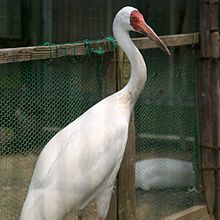
Bharathpur: Siberian Crane


The Keoladeo National Park or Keoladeo Ghana National Park formerly known as the Bharatpur Bird Sanctuary in Rajasthan, India is a famous avifauna sanctuary that sees thousands of rare and highly endangered birds such as the Siberian Crane which come here during the winter season. Over 230 species of birds are known to have made the National Park their home. It is also a major tourist centre with scores of ornithologists arriving here in the hibernal season. It was declared a protected sanctuary in 1971. It is also a declared World Heritage Site.
Bharathpur forest lodge
Bharathpur- 321001

Tuesday, July 19, 2011

Hampi: Vittala Temple ( stone chariot )


Hampi is a village in northern Karnataka state, India. It is located within the ruins of Vijayanagara, the former capital of the Vijayanagara Empire. Predating the city of Vijayanagara, it continues to be an important religious centre, housing the Virupaksha Temple, as well as several other monuments belonging to the old city. The ruins are a UNESCO World Heritage Site, listed as the Group of Monuments at Hampi.
Virupaksha Temple is the main center of pilgrimage at Hampi and has been considered the most sacred over the centuries. It is fully intact among the surrounding ruins and is still used in worship. The temple is dedicated to Lord Shiva, known here as Virupaksha, as the consort of the local goddess Pampa who is associated with the Tungabhadra River.
Cancellation depicts stone chariot at Virupaksha Temple.
Cancellation was introduced on 8th July 1975.
Hampi Branch Post Office
Bellary District-583215